

Snowdrops: The First Lifeline in the Garden Year


Snowdrops are often described as modest or delicate, but this understates their true significance. These small white flowers are among the most important plants in the garden calendar — not just for us, but for wildlife emerging at a time when survival hangs in the balance.
Appearing in late winter, often pushing through frozen ground, snowdrops mark the very beginning of the garden year. They are not simply a sign of hope for gardeners; they are a vital food source at a moment when little else is available.
For me, this is where good garden design truly begins — with an understanding that a garden is not only something to look at, but a living habitat.
Who Needs Snowdrops?
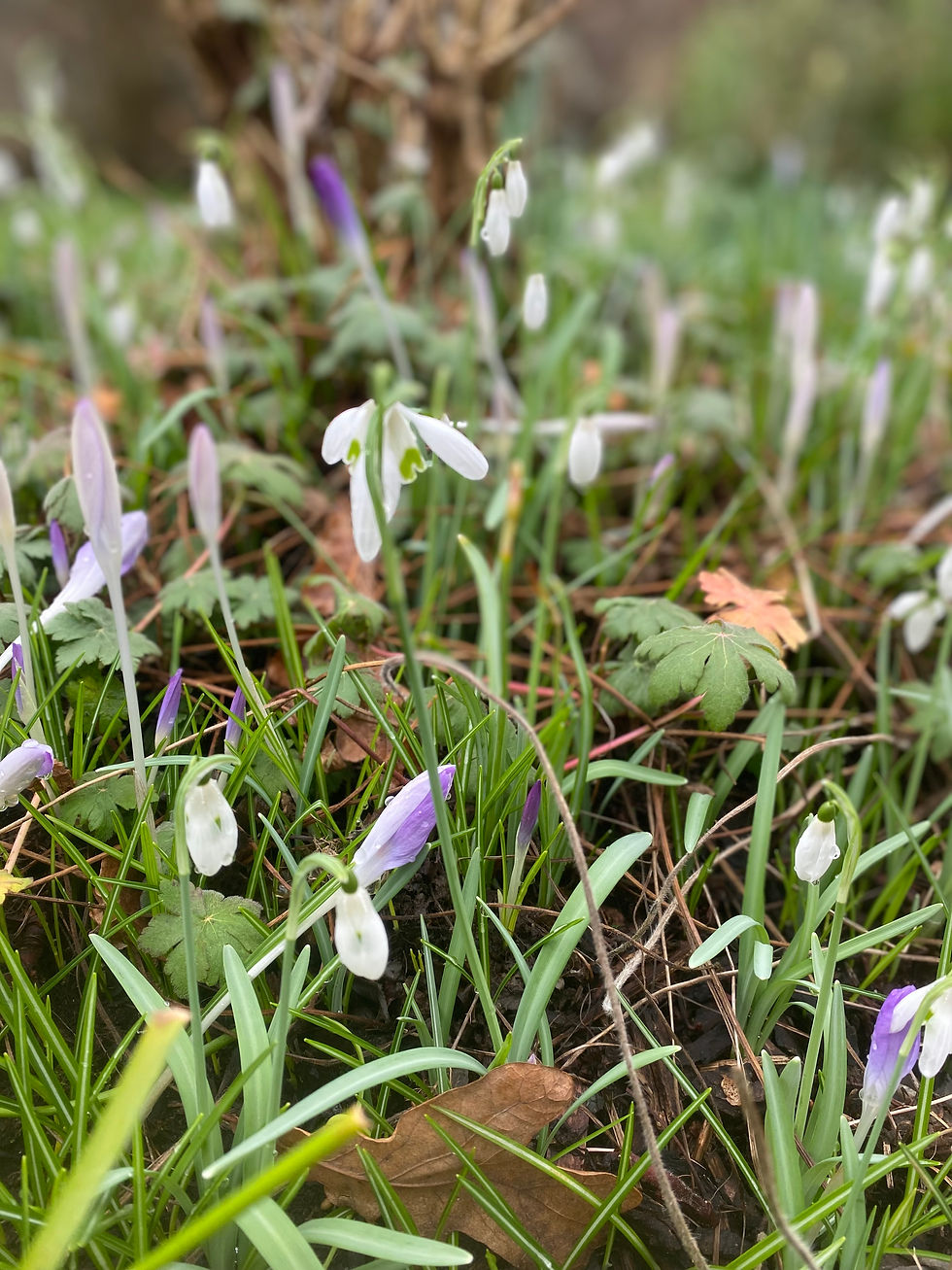
Snowdrops ( Galanthus nivalis ) flower from January to March, depending on location and weather. This makes them one of the earliest sources of nectar and pollen in the garden — a critical resource for insects waking from winter dormancy.
In particular, snowdrops support:
Queen bumblebees: These are among the first insects to emerge in late winter. Newly awakened queens need immediate energy to survive and begin establishing new colonies. Snowdrops offer accessible nectar at exactly the right time.
Honeybees (on mild winter days): During warmer spells, honeybees will venture out of the hive. Early flowers like snowdrops help sustain colonies before spring truly arrives.
Early solitary bees: Species such as mining bees and other ground-nesting solitary bees rely on early nectar sources to fuel reproduction. Without plants like snowdrops, many struggle to survive.
While snowdrops are not the sole food source for early-emerging insects, they form a vital part of the seasonal food chain. Remove these early links and everything that follows becomes weaker. Other late-winter and early-spring plants — such as Hellebores, Crocus, Winter Aconite, Pulmonaria, Mahonia and Willow (L-R below) are equally important, providing essential nectar and pollen when little else is available.
A Brief History of the Snowdrop
Snowdrops are native to parts of Europe and western Asia and have been cultivated in Britain for centuries. They were grown in medieval monastery gardens and later became popular in estate landscapes, churchyards, and woodland gardens.
Historically, snowdrops were valued not for spectacle, but for their reliability and quiet beauty. They thrived beneath trees, along hedgerows, and in semi-wild spaces — places where nature and cultivation overlapped.
In many ways, snowdrops reflect an older way of thinking about gardens: one that accepted seasonality, imperfection, and the rhythm of the natural world.
This is something I consciously draw on in my own design approach.
Why Early Flowers Matter for Biodiversity
Biodiversity isn’t created through a single dramatic gesture. It’s built through continuity.
For wildlife to thrive, food sources must exist throughout the year, not just in summer. Early flowers like snowdrops bridge the gap between winter dormancy and spring abundance.
Without them:
Early pollinators emerge to nothing
Queen bees fail to establish colonies
The knock-on effects ripple through the entire ecosystem
By contrast, gardens that include snowdrops, hellebores, early crocus and winter-flowering shrubs provide a steady progression of nourishment. These gardens feel calmer, more balanced, and more beautiful.
Life breeds life.
A Note about Planting Snowdrops
For the best results, snowdrops are best planted in the green rather than as dry bulbs. This means lifting and replanting them just after flowering, while the leaves are still green and active. Snowdrop bulbs dry out very easily in storage, which is why planting dry bulbs often leads to poor or patchy results. By planting in the green—typically from late February to March—the plants can continue photosynthesising, helping them re-establish quickly and replenish the bulb’s energy reserves. This approach results in healthier plants, stronger clumps, and far more reliable flowering in the years that follow.
A Lesson in Patience and Long-Term Thinking and Designing with Responsibility and Care
Snowdrops also teach us patience.
They multiply slowly, spreading gently over time. The most beautiful displays are rarely instant; they are the result of years of subtle naturalisation. This long-term view is something I encourage clients to embrace.
Good gardens are rarely finished in a single season. They evolve — often in carefully planned stages — allowing plants to establish properly and the overall design to settle into place.
A garden designed with longevity in mind doesn’t just look good in year one. It improves year after year.
When I design a garden, I am always thinking beyond how it looks from the kitchen window or terrace. I think about what happens beneath the soil, in the hedge line, under the trees, and through the quieter months of the year.
Including early-flowering plants is not about ticking a sustainability box but a meaningful way of ensuring a garden functions as a habitat and food source, as well as a place of enjoyment for people.
Where to See Snowdrops in Devon and Surrounding Counties
Seeing snowdrops established in the landscape — naturalised, layered, and allowed to spread over time — is one of the best ways to understand their quiet power. The following places offer beautiful examples of how early flowers can shape a landscape and support wildlife.
Devon
Coleton Fishacre
Woodland walks and sheltered valleys come alive with snowdrops in late winter, showing how bulbs thrive beneath deciduous trees.
Castle Drogo
A wonderful example of snowdrops woven into a rugged, upland landscape, softening stone and structure.
Killerton
Famous for its extensive naturalised snowdrops, particularly through parkland and woodland edges.
Cornwall
Trebah Garden
Early bulbs thrive here thanks to the mild microclimate, offering an excellent lesson in site-sensitive planting.
Glendurgan Garden
Snowdrops appear quietly beneath trees, reinforcing the importance of layered, seasonal planting.
Somerset
Stourhead
One of the finest examples of snowdrops used at scale within a designed landscape that still feels natural and timeless.
The Bishop’s Palace Gardens
A beautiful demonstration of early flowers integrated into formal and informal spaces alike.
Snowdrop Valley- Wheddon Cross, Exmoor
Run by volunteers and offering an incredible show until Sunday 22nd February 2026.
Dorset
Kingston Lacy
Snowdrops naturalised through parkland and woodland margins, illustrating how early planting supports biodiversity across large estates.

Designing Wildlife-Friendly Gardens in Devon and the South West
As a garden designer based in Devon, much of my work is shaped by the landscapes, soils and wildlife of the South West. From coastal gardens to countryside settings, this region has a long tradition of gardens that sit gently within their surroundings — places where planting feels rooted, seasonal and purposeful.
Designing gardens in Devon, Cornwall, Somerset and Dorset means thinking carefully about biodiversity, local ecology, and the rhythm of the year. Early-flowering plants such as snowdrops are particularly important here, where mild winters can prompt insects to emerge before many gardens are ready to support them.
Whether I am creating a new planting plan for a private garden, reworking an established space, or advising on phased planting over several years, my approach is always the same: to design gardens that are beautiful, resilient, and supportive of wildlife — not just in summer, but throughout the year.
If you’re looking for a garden designer in Devon who specialises in naturalistic, wildlife-friendly gardens with strong seasonal structure, I’d be happy to help.


Comments